
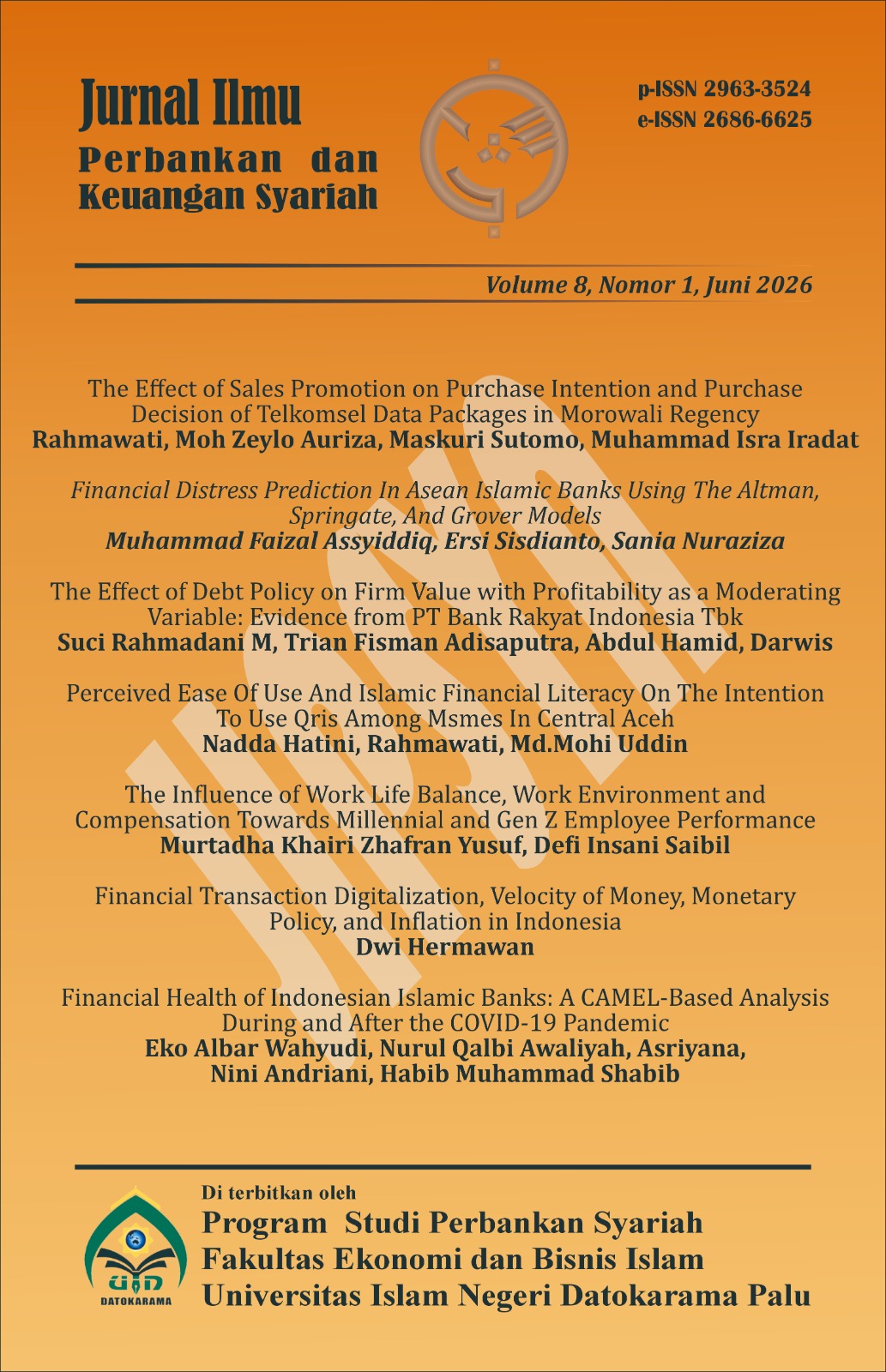
Financial Health of Indonesian Islamic Banks: A CAMEL-Based Analysis During and After the COVID-19 Pandemic
Financial Health of Indonesian Islamic Banks: A CAMEL-Based Analysis During and After the COVID-19 Pandemic
DOI:
https://doi.org/10.24239/jipsya.v8i1.405.116-136Keywords:
CAMEL, Islamic banking, bank healthAbstract
This study aims to analyze the financial health of Indonesian Islamic commercial banks during and after the COVID-19 pandemic using the CAMEL framework. Data from nine Islamic commercial banks in Indonesia for the 2020–2024 period were examined using a descriptive quantitative approach with CAR, KAP, NPM, ROA, BOPO, and FDR as financial health indicators. Results show that Islamic banks generally maintained strong capital adequacy and controlled asset quality, while profitability, operational efficiency, and liquidity varied across banks. The average CAMEL score improved from the fairly healthy category in 2020–2021 to the healthy category in 2022–2024. Bank Mega Syariah, Bank BTPN Syariah, and Bank NTB Syariah recorded the strongest financial health, whereas Bank Aladin Syariah and KB Bank Syariah still faced challenges in profitability and efficiency. These findings suggest that Islamic bank soundness is bank-specific and component-specific. Management and regulators should prioritize efficiency, earning capacity, and liquidity control beyond capital adequacy. This study is descriptive and does not test causal relationships among financial ratios
References
Ab-Rahim, R., Kadri, N., Ee-Ling, A.-C., & Dee, A. A. (2018). CAMEL analysis on performance of ASEAN public listed banks. International Business Research, 11(4), 96. https://doi.org/10.5539/ibr.v11n4p96
Alhammadi, S., Professor, E., Archer, S., & Asutay, M. (2020). Risk management and corporate governance failure in Islamic banks: A case study. Journal of Islamic Accounting and Business Research, 11(9), 1921–1939. https://doi.org/10.1108/jiabr-03-2020-0064
Antonio, M. S. (2001). Bank syariah: Dari teori ke praktik. Gema Insani.
Astuti, R. P. (2022). Pengaruh CAR, FDR, NPF, dan BOPO terhadap profitabilitas perbankan syariah. Jurnal Ilmiah Ekonomi Islam, 8(3), 3213–3223. https://doi.org/10.29040/jiei.v8i3.6100
Aulia, R., & Anwar, S. (2021). Pengaruh biaya operasional dan pendapatan operasional, net operating margin, dana pihak ketiga, dan capital adequacy ratio terhadap profitabilitas bank syariah. Bukhori: Kajian Ekonomi Dan Keuangan Islam, 1(1), 21–38. https://doi.org/10.35912/bukhori.v1i1.437
Bahri, E. S., Zam-zamiyah, F. T., & Nasution, N. (2022). The measurement of the financial performance of Islamic commercial banks in Indonesia with the Maqashid Sharia Index and Comparative Performance Index approach. MALIA: Journal of Islamic Banking and Finance, 6(2), 131–144. https://doi.org/10.21043/malia.v6i2.16634
Butt, U., & Chamberlain, T. (2025). Performance of Islamic banks during the COVID-19 pandemic: An empirical analysis and comparison with conventional banking. Journal of Risk and Financial Management, 18(6). https://doi.org/10.3390/jrfm18060308
Damayanti, C., Nurdin, A. A., & Widayanti, R. (2021). Analisis pengaruh NPF, CAR, dan FDR terhadap profitabilitas bank umum syariah di Indonesia periode 2015-2019. Journal of Applied Islamic Economics and Finance, 2(1), 9–20. https://doi.org/10.35313/jaief.v2i1.2818
Danlami, M. R., Abduh, M., & Abdul Razak, L. (2022). CAMELS, risk-sharing financing, institutional quality and stability of Islamic banks: Evidence from 6 OIC countries. Journal of Islamic Accounting and Business Research, 13(8), 1155–1175. https://doi.org/10.1108/JIABR-08-2021-0227
Devi, H. P. (2021). Pengaruh rasio kesehatan bank terhadap return on assets pada bank umum syariah di Indonesia. Owner: Riset Dan Jurnal Akuntansi, 5(1), 1–11. https://doi.org/10.33395/owner.v5i1.311
Fadhilah, A. R., & Suprayogi, N. (2019). Pengaruh FDR, NPF dan BOPO terhadap ROA perbankan syariah di Indonesia. Jurnal Ekonomi Syariah Teori Dan Terapan, 6(12), 2369–2380. https://doi.org/10.20473/vol6iss201912pp2369-2380
Fakhrunnas, F., Boubechtoula, Y., Nahda, K., & Rezoanul Hoque, M. (2024). Islamic bank stability and efficiency: A cross-country analysis. Economic Journal of Emerging Markets, 16(2), 114–123. https://doi.org/10.20885/ejem.vol16.iss2.art2
Ghenimi, A., Chaibi, H., & Omri, M. A. (2024). Risk and performance of Islamic and conventional banks under COVID-19 pandemic: Evidence from MENA region. Arab Gulf Journal of Scientific Research, 42(4), 1788–1804. https://doi.org/10.1108/AGJSR-03-2023-0098
Iqbal, M., Hakim, L., & Aziz, M. A. (2024). Determinants of Islamic bank stability in Asia. Journal of Islamic Accounting and Business Research, 17(1), 162–178. https://doi.org/10.1108/JIABR-07-2022-0174
Ismail. (2016). Perbankan Syariah (4th ed.). Prenadamedia Group.
Kasmir. (2019). Analisis Laporan Keuangan (12th ed.). RajaGrafindo Persada.
Lestari, P., & Hardiyanti, W. (2020). Analysis of Islamic banks in Indonesia and Malaysia using CAMEL. Jurnal Ilmiah Komputerisasi Akuntansi, 13(1), 89–99. https://doi.org/10.51903/kompak.v13i1.164
Maniam, S. (2024). Determinants of Islamic fintech adoption: A systematic literature review. Journal of Islamic Marketing, 15(11), 2916–2936. https://doi.org/10.1108/JIMA-11-2023-0373
Miah, M. D., & Uddin, H. (2017). Efficiency and stability: A comparative study between Islamic and conventional banks in GCC countries. Future Business Journal, 3(2), 172–185. https://doi.org/10.1016/j.fbj.2017.11.001
Minarni, Abidin, M., & Ekowati, V. M. (2023). The influence of financial performance on profitability of sharia commercial banks in Indonesia using the CAMEL method. Journal of Islamic Economics Lariba, 9(2), 329–352. https://doi.org/10.20885/jielariba.vol9.iss2.art4
Muhammadinah, M., & Pratama, M. R. R. (2025). Financial performance analysis of Islamic banking in Indonesia. I-Finance: A Research Journal on Islamic Finance, 10(2), 504–523. https://doi.org/10.19109/ifinance.v10i2.28664
Nasution, S., Yafiz, M., & Anggraini, T. (2023). Financial performance analysis of PT Bank Syariah Indonesia (BSI) for the 2021-2022 period using the CAMEL method. Indonesian Interdisciplinary Journal of Sharia Economics (IIJSE), 6(3), 1654–1665. https://doi.org/10.31538/iijse.v6i3.3806
Nguyen, L.-H., Le, T. D. Q., & Ngo, T. (2023). Efficiency and performance of Islamic banks amid COVID-19. Journal of Islamic Accounting and Business Research, 16(5), 873–889. https://doi.org/10.1108/JIABR-05-2022-0129
Otoritas Jasa Keuangan. (2025a). Siaran Pers: Kinerja Positif Perbankan Syariah 2024. https://ojk.go.id/id/berita-dan-kegiatan/siaran-pers/Pages/Kinerja-Positif-Perbankan-Syariah-2024.aspx
Otoritas Jasa Keuangan. (2025b). Snapshot Perbankan Syariah Indonesia Desember 2024. https://ojk.go.id/id/berita-dan-kegiatan/publikasi/Pages/Snapshot-Perbankan-Syariah-Indonesia-Desember-2024.aspx
Otoritas Jasa Keuangan. (2025c). Statistik perbankan syariah Desember 2024.
Rakhmat, A. S., Fahamsyah, M. H., Nurastuti, P., & Ainulyaqin, M. H. (2024). Analisis CAMEL pada bank syariah dan dampaknya terhadap risiko kredit. Jurnal Ilmiah Ekonomi Islam, 10(03), 3061–3068. https://doi.org/10.29040/jiei.v10i3.15429
Riza, A. F., & Wijayanti, D. M. (2024). Strengthening a sustainable Islamic financial industry through digital banking. Journal of Islamic Marketing, 15(11), 2732–2758. https://doi.org/10.1108/JIMA-01-2023-0025
Shahriar, A., Mehzabin, S., Ahmed, Z., Döngül, E. S., & Azad, Md. A. K. (2023). Bank stability, performance and efficiency: An experience from West Asian countries. IIM Ranchi Journal of Management Studies, 2(1), 31–47. https://doi.org/10.1108/irjms-02-2022-0017
Sulistyorini, E., Sarasmitha, C., June, C. G. T., & Jauhari, B. (2024). Financial performance: A study of CAR and FDR impact on ROA in Indonesian Islamic banks. Business Management Research, 3(1), 42–57. https://doi.org/10.26905/bismar.v3i1.13505
Surat Edaran Bank Indonesia No. 6/23/DPNP Tentang Sistem Penilaian Tingkat Kesehatan Bank Umum, Pub. L. 6/23/DPNP (2004).
Zikri, S. A., Tamara, D. A. D., Mai, M. U., & Nurdin, A. A. (2023). Analisis pengaruh CAR, NPF, BOPO, dan FDR terhadap ROA: Studi kasus PT Bank Muamalat Indonesia Tbk. Journal of Applied Islamic Economics and Finance, 3(2), 286–301. https://doi.org/10.35313/jaief.v3i2.3756
Downloads
Published
How to Cite
Issue
Section
License
Copyright (c) 2026 Jurnal Ilmu Perbankan dan Keuangan Syariah
This work is licensed under a Creative Commons Attribution-NonCommercial 2.0 Generic License.


.png)