
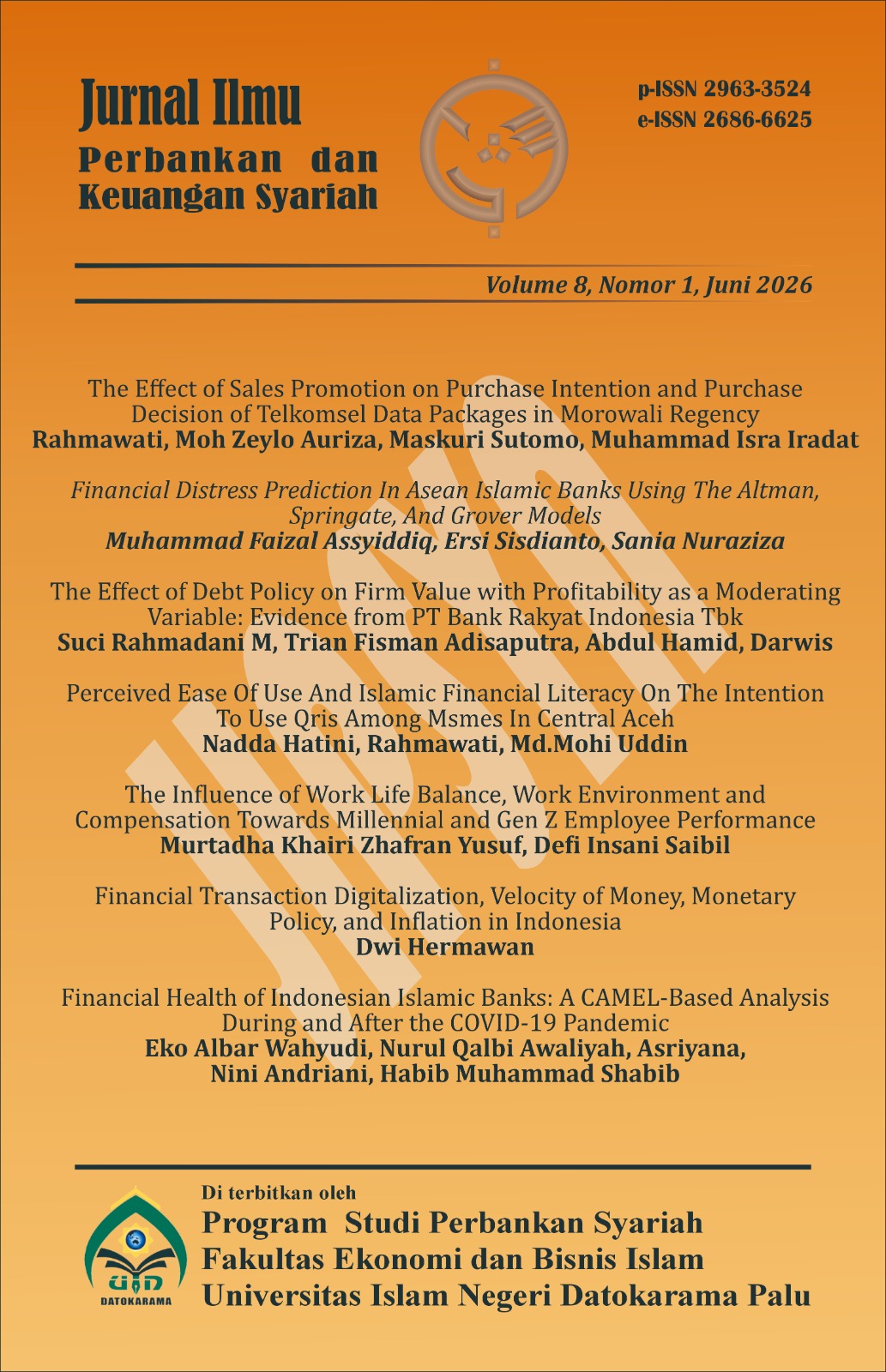
Perceived Ease Of Use And Islamic Financial Literacy On The Intention To Use Qris Among Msmes In Central Aceh
Perceived Ease Of Use And Islamic Financial Literacy On The Intention To Use Qris Among Msmes In Central Aceh
DOI:
https://doi.org/10.24239/jipsya.v8i1.400.57-72Keywords:
QRIS Usage Intention;MSMEs, Sharia Financial Literacy, Perceived Ease of Use, Central AcehAbstract
This study aims to analyze the influence of Islamic financial literacy and perceived ease of use on the interest in using QRIS among MSMEs in Central Aceh Regency. This study used a quantitative approach with a survey method by distributing questionnaires to 91 respondents selected using a purposive sampling technique. Data analysis was performed using multiple linear regression with the help of SPSS software. The results of the normality test showed a significance value of 0.020 (<0.05), which means the data was not normally distributed, but the analysis was continued because the sample size was sufficient. The coefficient of determination (R²) value of 0.970 indicates that the variables of Islamic financial literacy and perceived ease of use are able to explain 97% of the variation in interest in using QRIS. The results of the simultaneous test (F) showed a significant effect with a significance value of 0.000 (<0.05). Partially, perceived ease of use has a positive and significant effect on interest in using QRIS, while Islamic financial literacy has a positive but insignificant effect. Thus, perceived ease of use is a dominant factor in increasing interest in using QRIS among MSMEs. In conclusion, perceived convenience is the dominant factor in increasing interest in using QRIS, while Islamic financial literacy has not played a significant role6
References
Adrian Sena Wangi, B., Susanto, E., & others. (2025). The influence of Islamic financial literacy and inclusion on Islamic financial management in Generation Z.Economics, Finance, Investment and Sharia (EQUITY), 6(3), 477–485. https://doi.org/10.47065/EKUITAS.V6I3.6678
Ahmad, N. H., Ramayah, T., & Halim, H. A. (2024). Understanding fintech adoption among SMEs: The role of perceived ease of use and trust. Journal of Enterprise Information Management, 37(1), 145–162.
Akhyar, R. A., & Sisilia, K. (2023). The influence of perceived usefulness and perceived ease of use on the decision to use the Indonesian Standard Quick Response Code (QRIS) digital payment.Management Studies and Entrepreneurship Journal (MSEJ), 4(4), 3944–3954. https://doi.org/10.37385/MSEJ.V4I4.1653
Alalwan, A. A. (2023). Mobile food ordering apps: An empirical study of the factors affecting customer e-satisfaction and continued intention to reuse. International Journal of Information Management Data Insights, 3(1), 100144.
Alamsyah, A., Sugianto, E., & Rahman, F. (2025). The role of Islamic financial literacy in digital financial services adoption. Journal of Islamic Marketing, 16(2), 389–405.
Alamsyah, R., Suhardi, S., & Sugianto, E. (2025). The influence of sharia financial literacy, risk perception, and social influence on sharia financial inclusion of Gen Z: The role of interest mediation. AKUA: Journal of Accounting and Finance, 4(2), 117–128. https://doi.org/10.54259/AKUA.V4I2.4199
Azzahra, T., Perdani, M., Fitriati, A., Kusbandiyah, A., & Azizah, S. N. (2025). The influence of perceived benefits and perceived risks on the intention to use QRIS continuously mediated by trust in generation Z.Journal of Accounting and Finance Management, 6(2), 791–808. https://doi.org/10.38035/JAFM.V6I2.1984
Bahtiar, Mukhsin, M., & Atiah, I. N. (2025). The influence of Islamic financial literacy, perceived ease of use, perceived usefulness, service features, and security on interest in using LinkAja Syariah e-money.Masharif Al-Syariah Journal: Journal of Islamic Economics and Banking, 10(3). https://doi.org/10.30651/JMS.V10I3.27036
Dwivedi , Y. K. , Hughes , D. L. , Baabdullah , A. M. , Ribeiro-Navarrete , S. , Giannakis , M. , Al-Debei , M. M. , Dennehy , D. , Metri , B. , Buhalis , D. , Cheung , C. M. K. , Conboy , K. , Doyle , R. , Dubey , R. , Dutot , V. , Felix , R. , Goyal , D. P. , Gustafsson , A. , Hinsch , C. , Jebabli , I. , ... Wamba , S. F. (2023).
Fecira, D., & ABDULLAH, T. M. K. (2020). Analysis of e-learning acceptance using the Technology Acceptance Model (TAM). Journal of Economics, Social Sciences & Humanities, 2(04), 35-50.
Fitria, S., Anita, E., & Rahayu, Y. (2024). Sharia financial literacy and its influence on the use of digital financial services.Journal of Islamic Economics, 8(2).
Gunarsih, T., &Febriyani, D. (2025). Does trust mediate the influence of perceived usefulness and perceived ease of use on interest in using QRIS?Business Studies, 33(2), 124–136. https://doi.org/10.32477/JKB.V33I2.1180
Hidayat, F., &Kharismaputra, A. P. (2025). Evaluation of the Influence of Perceived Usefulness and Ease of Use on PILAM and E-Journal Use Using the Technology Acceptance Model. Adoption of Technology and Information Systems (ATASI), 4(2), 204-213.
Judijanto, L., Ohyver, D. A., Kusumastuti, S. Y., & Masri, M. (2025).Financial literacy: Theory and implementation. PT Sonpedia Publishing Indonesia.
Kartini, T. K., &Mashudi, U. (2022). Financial literacy of boarding students as prospective economics educators at the Faculty of Teacher Training and Education, University of Jember. Promotion: Journal of the Economics Education Study Program, 10(2).
Liébana-Cabanillas, F., Marinkovi?, V., & Kalini?, Z. (2023). A SEM-neural network approach for predicting antecedents of m-commerce acceptance. International Journal of Information Management, 68, 102467.
Lusardi, A. (2023). Financial literacy and the need for financial education: Evidence and implications. Journal of Economic Perspectives, 37(3), 1–20.
Nurhayati, S., Rahman, A., & Fauzi, A. (2024). Financial literacy and digital readiness on MSMEs performance: Evidence from developing countries. Journal of Small Business and Enterprise Development, 31(2), 210–225.
Pradesyah, R., Sitepu, F. A., & Ismail, A. H. (2026). The influence of perception of benefits and sharia principles on the intention to use QRIS sharia in halal MSMEs. Majapahit Journal of Islamic Finance and Management, 6(1), 92–107. https://doi.org/10.31538/MJIFM.V6I1.689
Ramadhana, N. F., &Kusumawati, E. (2026). Analysis of students' perceptions of the benefits of convenience, security trust, user experience, financial literacy, and transaction risks regarding the use of QRIS.Journal of Information Systems Management Economics, 7(3), 2428–2440. https://doi.org/10.38035/JEMSI.V7I3.7413
Saifudin, F., Satriawan, B., Amali, I., Eko, M., & Kalla, Z. (2025). The Influence of Perceived Usefulness, Trust, and Ease of Use on Interest in Using QRIS. docx. Determination: Journal of Research in Management Economics and Accounting, 3(2), 256-266.
Sepdiana. (2025). The role of Islamic financial literacy in shaping the Islamic investment decisions of millennial and Gen Z workers.Balance: Journal of Accounting and Management, 4(1), 246–253. https://doi.org/10.59086/JAM.V4I1.685
So what if ChatGPT wrote it? Multidisciplinary perspectives on opportunities, challenges and implications of generative conversational AI for research, practice and policy. International Journal of Information Management, 71, 102642.
Sugiyono. (2022).Quantitative, qualitative, and R&D research methods. Bandung: Alfabeta.
Suhardi, S. (2025). Mapping Islamic financial inclusion literature: Trends, key issues, and future research directions. Indonesia Accounting Research Journal, 12(4), 149–163. https://doi.org/10.35335/IACRJ.V12I4.466
Thaha Saifuddin Jambi, U. (2025). The influence of financial literacy and internet penetration on Islamic financial inclusion in Indonesia.ILTIZAM Journal of Shariah Economics Research, 9(2), 167–191. https://doi.org/10.30631/8KSZEJ69
Yuniarti, Y., &Herlina, L. (2025). Analysis of perceptions of ease and security of using QRIS as a digital payment tool on Gen Z's interest in using QRIS in Bandung City.Al-Zayn: Journal of Social Sciences & Law, 3(3), 3025–3037. https://doi.org/10.61104/ALZ.V3I3.1798
Downloads
Published
How to Cite
Issue
Section
License
Copyright (c) 2026 Jurnal Ilmu Perbankan dan Keuangan Syariah
This work is licensed under a Creative Commons Attribution-NonCommercial 2.0 Generic License.


.png)